Styles
Fence Styles for Telford Gardens, Compared
Closeboard, hit-and-miss, panels with trellis, low pickets: each does a different job. Here is what each suits, and one small gap worth leaving in whichever you choose.
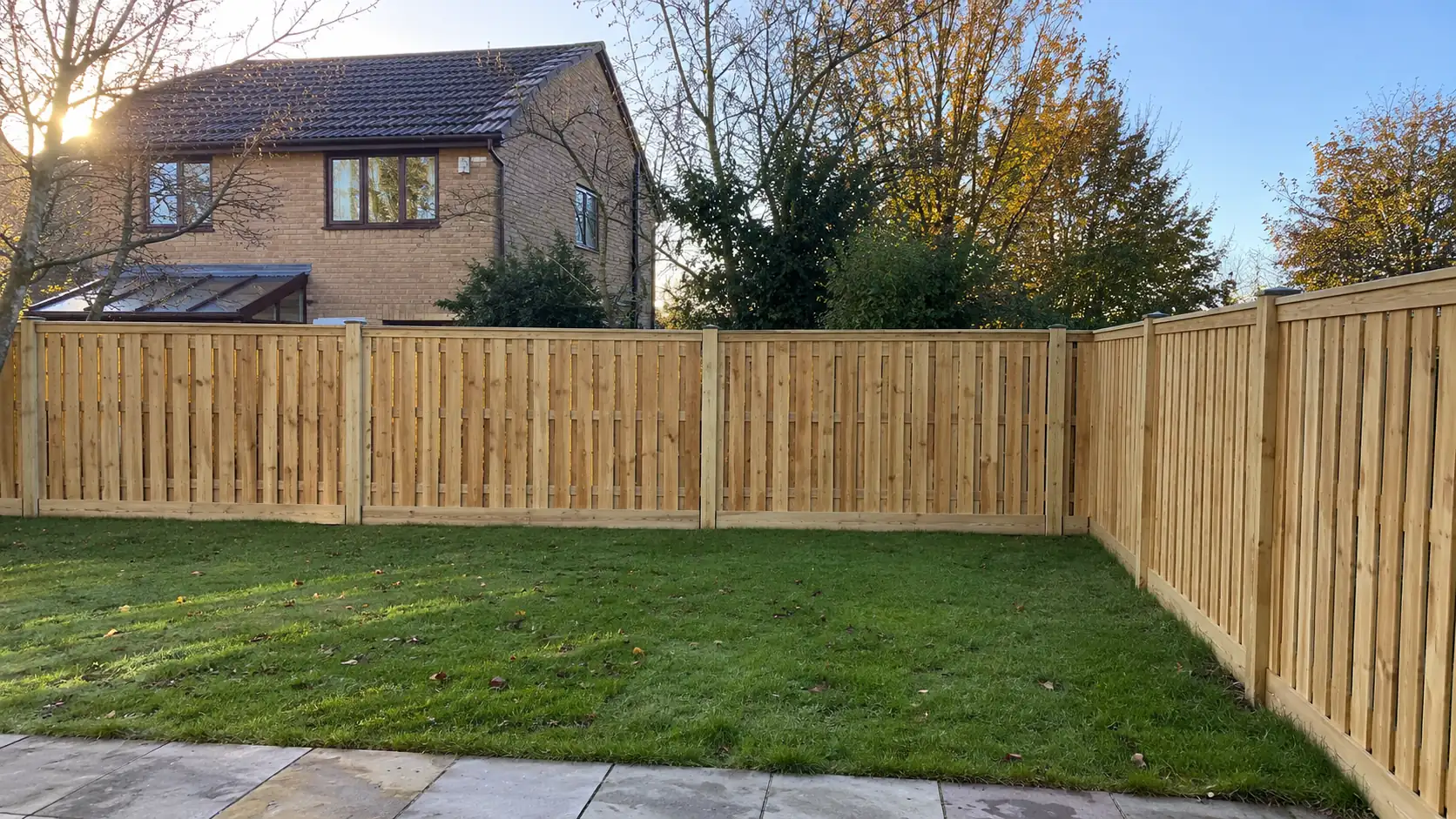
Five styles, side by side
| Style | Looks like | Suits | Worth asking |
|---|---|---|---|
| Closeboard | Overlapping vertical boards on rails | Back-garden boundaries where a solid screen is wanted | Which timber, and how the bottom edge is finished |
| Hit-and-miss | Boards screwed to opposite faces of the rails in turn, so each gap shows the next board behind | Plots where a fully solid screen feels heavy | How wide the gaps are and how each side looks |
| Fence panels | Ready-made panels held between slotted posts | Sloping runs that step, and quicker jobs | Panel quality and what is used under each step |
| Panels with trellis | A panel topped by a trellis strip | Gardens overlooked from above, with climbers | The finished height, set against the limit |
| Picket | Low, spaced uprights, often with a gate to match | Older terraces and cottage fronts | Height against a pavement, and any Gorge rules |
Which garden suits which
- A sloping back garden. Panels in slotted posts step, and traditional fencing can be raked. See sloping gardens.
- A patio overlooked by a neighbour. Height does the work, and height has a ceiling. See estates.
- A front garden beside the pavement. The Planning Portal sets a lower height next to a highway, and a picket is a common answer on an older street.
- A garden in the Gorge. Extra rules apply at the front, so read the Gorge page first.
One small gap for hedgehogs
The Hedgehog Street campaign says hedgehogs travel around one mile every night through parks and gardens in search of food and a mate, and that one reason they are struggling is that fences and walls are becoming more secure, which shrinks the land open to them. Source: Hedgehog Street, Link your garden with a hedgehog highway.
Its advice is specific. A gap 13 cm by 13 cm is sufficient for any hedgehog and too small for nearly all pets. It can be made by removing a brick from the bottom of a wall, by cutting a small hole in a fence that has no gaps, or by digging a channel under a wall, fence or gate. The charity also says the ideal answer is a hedge, which gives shelter and food as well as a route through, and it asks people to map their gap on its BIG Hedgehog Map.
On a shared boundary it is polite to mention it to the neighbour first. In the request you can ask for a gap to be built into the foot of a panel or gravel board, which is easier than cutting one afterwards.
Start from what you want the fence to do
- A solid screen. Closeboard and trellis-topped panels give the most cover.
- A lighter line. Hit-and-miss and picket let the garden feel open at the edge.
- The look from the kitchen window. Decide which face of the fence you will see most, and ask which side is the finished one.
- Keeping a view. Lower fences along a front or a lane keep the street in sight, within the height limit.
- Room for climbers. A trellis strip or wires on a panel fence give a rose or clematis something to hold.
Every style can be made well or badly, so the questions at the end of the table matter as much as the style itself. Ask what the posts are, how the boards are fixed and what is done at the bottom edge.
A note on rules
Whichever style you pick, the same checks apply: the height limit, any condition or deed, and the extra rules in the Gorge. They are on the pages linked above.
Settled on a style? Send the details across.
Ask about your fence