Slopes
Fencing a Sloping Garden in Telford: Steps or Rake
A fence on level ground has one job. On a slope it has to choose between following the ground and stepping across it, and each choice leaves something different underneath.
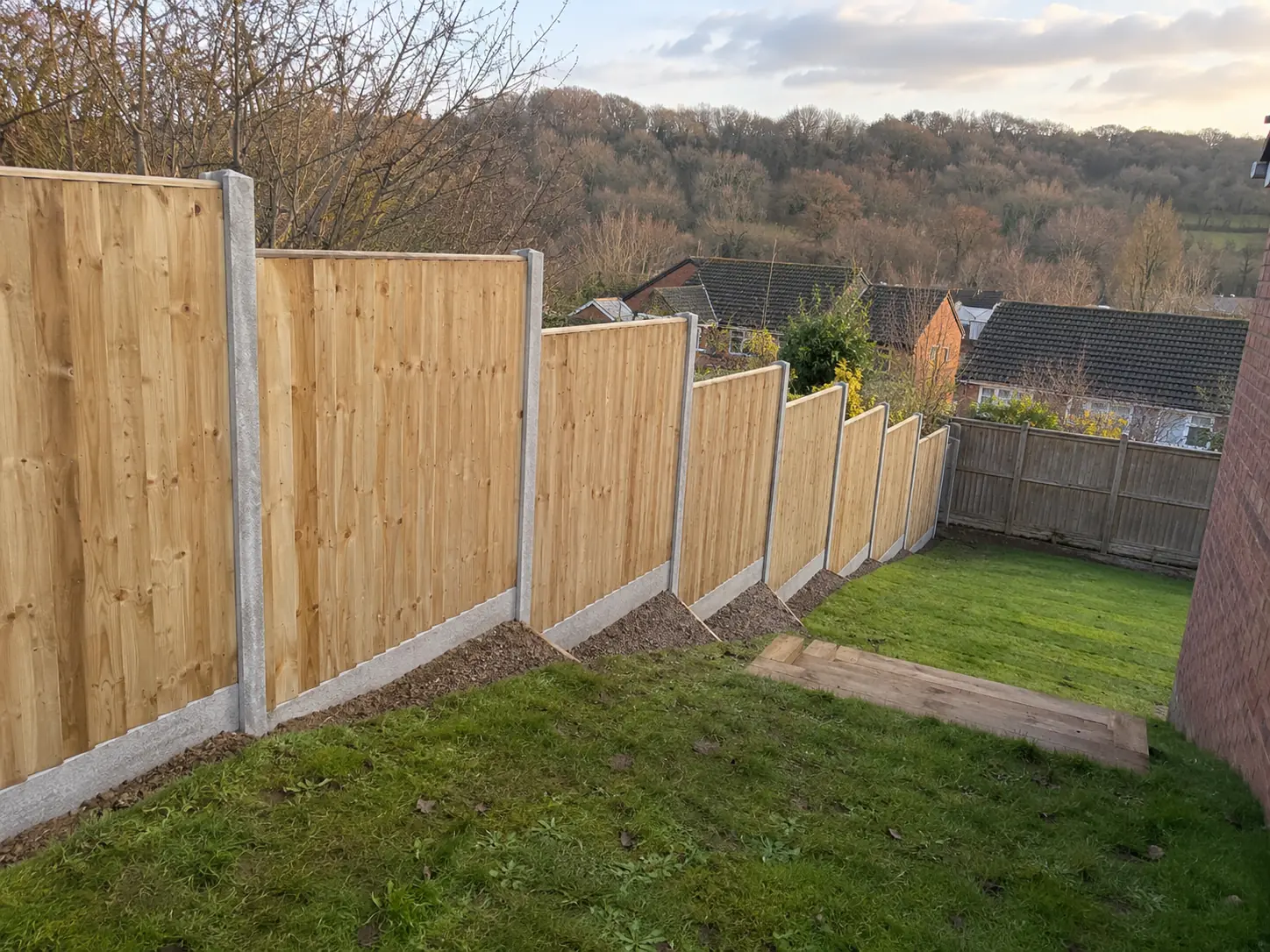
Two ways to follow the ground
Fence makers describe two methods. The guide from Jacksons Fencing, Installing fencing on a slope (a fence maker’s guide) calls them raking and stepping. Raking means the fence follows a gradual slope, which suits traditional fencing built board by board. Stepping suits panels held in slotted posts, which step up or down with the slope. The maker also says the choice depends on the style of fence.
Treat that as one maker’s view. It is useful because it is specific, and it is worth asking an installer which they would use on your slope and why.
Stepping: every top stays level
The same guide advises measuring the difference in height across the slope and then stepping down evenly, or stepping every few panels. A run where the steps were not measured can leave gaps beneath the fence, uneven gradients and posts that finish too low or sit awkwardly high.
- A post should finish flush with the highest panel it holds, or slightly higher, so no panel is left without full support.
- Panels should be kept level, with a spirit level on top before fixing, because tilting a panel would tilt the post as well.
- On slotted posts each step leaves a gap in the post above the lower panel, which the maker fills with short infill pieces cut to size.
What goes under the steps
Every step opens a triangle of space under the lower panel. The guide’s answer is the gravel board: a treated board that can sit against the ground, and that may need to go into the soil slightly to keep the gap small. It adds that without them there can be large triangular gaps and the timber is no longer protected from the ground.
Some installers use several gravel boards to hold the base of the fence at a consistent height along a boundary. If that look matters to you, say so before the quote.
Stepped or raked, side by side
| Stepped | Raked | |
|---|---|---|
| Tops of the fence | Level in each section, with a drop between sections | Parallel to the ground, so they slope with it |
| Usual build | Panels in slotted posts | Traditional fencing built up on rails |
| The gap beneath | A triangle under each step, filled by gravel boards | Small, since the bottom follows the ground |
| Look | A staircase line | A single line down the hill |
| Worth asking | How tall is each step, and what happens at the posts? | Does the style you want suit a sloped run? |
Gates on a slope
The same maker notes that gates are often trickier than panels, because a gate needs clearance beneath it to open and close. If a gate is part of the job on falling ground, mention which way it should swing and where the ground rises.
Stepped-fence helper
For a sloping run only. Type the length of the boundary and how far the ground falls along it, in metres. The helper shows how many panels the run needs and how tall each step would be, if no step is allowed above the limit you set.
Only a starting point for a chat with an installer, and not a design. Panel widths vary, so swap in the one an installer gives you. The tool carries no prices.
Not every Telford garden falls away, and no source on this page says how many do. The point is only that if yours does, the quote should say how the fence will handle it.
Slope to describe? Send the details across.
Ask about your fence